Ascendant Sign Calculation Guide for Those Who Do Not Know Their Birth Time
Contents
- What Is Certain Without a Birth Time, and What Is Not? (time windows, managing uncertainty)
- 4 Practical Verification Methods
- Time Window → Possible Ascendant Table
- Common Errors and Safety Margin
- Step-by-Step Mini Rectification Form
- Next Step: Full Rectification or Approximate Chart? (decision tree)
- Try It Now: There’s a Way Even Without Knowing the Time
Hello, I am Astrologer Thalia Shade.
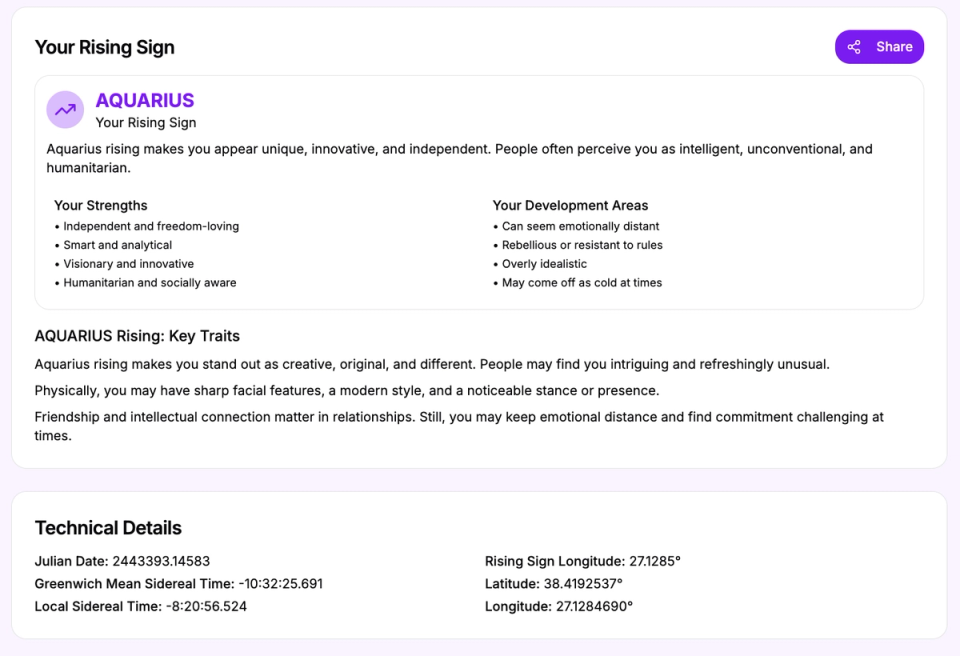
One of the questions I receive most often from my clients is how to calculate the ascendant sign when the birth time is unknown. The ascendant (ASC) is the gateway to the astrological chart; even a difference of a few minutes can change the houses, aspects, and the overall balance of the interpretation. In this guide, I will explain step by step practical ways to find the ascendant sign without knowing the exact time, using time windows, verification methods, mini rectification and a decision tree. At the end of the article, you will also find a tool you can immediately use for your own chart: Ascendant Sign Calculator.
What Is Certain Without a Birth Time, and What Is Not? (time windows, managing uncertainty)
Things that are certain or almost certain
- Sun sign: Unless you were born very close to the time the Sun changes signs, it remains fixed.
- Mercury & Venus sign: Since they are usually close to the Sun, they are less affected by the time of day (if there is no sign change on that day, they remain fixed).
- Signs of the planets: If a planet does not change signs on that day, it is generally fixed.
Those who are uncertain/unstable
- Rising sign (ASC): Changes approximately every ~2 hours; as the time range widens, the number of possible options increases.
- House placements: All houses rotate according to the Ascendant; house themes (career/MC, family/IC, relationships/7th house, etc.) shift rapidly.
- Moon sign: The Moon moves about 12–13° per day; within a single day it can change signs. If the time range is broad, it may be necessary to keep two possible options for the Moon sign.
Managing uncertainty (recommendation)
- Set the time window:For example, “8–11 AM”.
- According to this window, draw up the list of possible Ascendants.
- Narrow down with a checklist and event matchingand reduce the options to 1–2 candidates.
- If necessary, perform a mini rectification (explained below).
- Record the results % probability and update them with new developments in your life.
4 Practical Verification Methods
1) Sunrise / Noon method (differences between Sunrise and Noon charts)
If the time is unknown, there are two quick approaches:
- Sunrise chart: You cast the chart for sunrise. The Moon’s position is generally reliable; the houses are roughly set. It provides a picture close to the person’s “energy at the start of the day.”
- Noon chart (12:00 PM chart): You cast the chart for 12:00. By cutting the Moon’s maximum intraday movement in half, you get a safer Moon degree estimate. The houses also remain distributed in a more neutral way.
How to use it?
Cast both charts → compare the shared themes and the inconsistencies → match them with the person’s narrative and life data → take the more coherent one as your basis and keep the other as a backup hypothesis.
2) Event-based mini-rectification
Using a short form, gather 5–7 turning points; for these dates, check the transit/secondary progression influences’ contact with the ASC/MC axis:
- First move / change of city → generally IC/MC axis (4th/10th house) is triggered; Saturn/Jupiter/Uranus aspects are significant.
- Major surgery / bodily transformation→ 1st/6th houses, Mars/Saturn activations; again around the Ascendant.
- Graduation / starting a job / promotion → Harmonious Jupiter/MC aspects; the logic of Saturn cycles.
- Marriage / relationship beginning→ 7th house/Descendant and 5th house themes; Venus/Jupiter activations.
These correspondences narrow down the estimated time. For example, if Jupiter is in a close conjunction with the MC on that date, the MC degree and therefore the time window are recalibrated.
3) Physical clues & behavior patterns (ASC archetype checklist)
It is not a complete “atlas of the body,” but ASC archetypes provide a powerful clue:
- Fire rising (Aries/Leo/Sagittarius): Lively eye contact, a quick stride, an assertive way of opening; a tendency to be the “first to speak.”
- Earth rising (Taurus/Virgo/Capricorn): A balanced posture, measured gestures, a practical appearance; functionality in the wardrobe.
- Air Ascendant (Gemini/Libra/Aquarius): Expressive face/hands, socially engaging introduction, responding to questions with a question; light/relaxed style.
- Water rising sign (Cancer/Scorpio/Pisces): Deep, guarded gaze, intuitive approach, emotional pulse; rather than analyzing in the first minute,tofeel
Tip: Physical appearance alone is not sufficient; the first impression + initial behavior + the way one establishes connections should be evaluated together.
4) Moon degree and house shift warnings (which houses change the fastest?)
- The Moon moves about ~0.5° per hour; within a single day it can change signs. If the time range is wide, keep the Moon as two possibilities.
- ASC/MC axis shifts by a significant degree within minutes; 1–7 and 10–4 axes are the most sensitive areas.
- Relationships (7th house), career (10th house), home/family (4th house) themes can fall into completely different houses with a change of birth time. Therefore, interpreting the houses without fixing the Ascendant (ASC) is risky.
Time Window → Possible Ascendant Table
(Probable ASC list by time segments of the day; user scenarios)
Real-life warning: Ascendant sign varies according to date, latitude–longitude, and time zone; the windows are different in every city and season. Therefore, the table below shows the method; the exact list is provided dynamically by our Ascendant Sign Calculator tool.
How to Read This Table
- Input: Date of birth, place of birth (city/country), approximate time window (e.g., 08:00–11:00).
- Output: For that window, 2–4 possible Ascendants + a brief character/theme summary for each.
- Action: Compare yourself to the scenarios below and mark the option where you say, “yes, this is definitely me,”then move on to the mini rectification.
Example user scenarios
- Scenario A (08:00–10:00):
- Candidate 1: A more extroverted opening, quick to warm up, language of sports/competition → Fire rising candidate.
- Candidate 2: Quiet opening, observant, a stance that seeks reassurance in the first minute → Water Ascendant candidate.
- Prioritize the candidate whose behavior is closest to your own.
- Scenario B (2:00 PM–4:00 PM):
- Candidate 1: Emphasis on aesthetics/balance, mediation in the environment, elegance in the language of relationships → Air/especially the Libra axis.
- Candidate 2: Work/plan/performance agenda, monitoring concrete results, serious communication → Earth/especially the Capricorn axis.
- Scenario C (10:00 PM–12:00 AM):
- Candidate 1: Emphasis on home/privacy, initial questions about the family, a protective beginning → Water/Cancer axis.
- Candidate 2: Curiosity- and communication-focused opening, rapid Q&A, frequent jumping between multiple topics → Air/Gemini axis.
Note: Our tool mathematically takes the city/season difference into account; the table only illustrates the filtering logic.
Common Errors and Safety Margin
(incorrect daylight saving time, errors on the birth certificate, hospital record, etc.)
- Daylight Saving Time / Standard Time shifts: In past years, DST practices were different; some birth records may deviate by 1 hour from local time.
- Hospital record rounding: Records may have been rounded to 5 or 10 minutes, or evenhalf an hour.
- AM/PM confusion: Especially with births abroad, using the 12-hour clock format can cause mix-ups.
- Incorrect birthplace: Metropolitan districts have different latitude-longitude values; select the correct district/city.
- Document–memory discrepancy: Parents’ recollection may not match the civil/hospital record; note both, and add the difference as a safety margin.
My recommended safety margin:
- Parental memory:±45 min
- Hospital registration:±15–30 min
- If the uncertainty is large: ±60 min and run the table accordingly.
Step-by-Step Mini Rectification Form
(simple form logic that asks the user for 5–7 event dates)
1) Basic Information
- Date of birth, city/country
- Narrowest known time window (e.g. 07:30–09:00)
- Source: hospital record / civil registry / parental declaration
2) List of events (5–7 items; day/month/year)
- First major move or change of city
- Graduation / first job entry / promotion
- Marriage / beginning of an official union
- Childbirth / miscarriage / significant pregnancy period
- Major surgery/ significant physical transformation
- In life, the other date you call a “turning point” (an accident, starting a business, bankruptcy, an award, etc.)
3) Logic
- On each of these dates, the ASC/MC axis and the 1st/4th/7th/10th houses are examined for activations.
- The major outer planets (Saturn/Jupiter/Uranus/Neptune/Pluto) and solar eclipses in close aspects refine the time to within about 15–30 minutes.
4) Conclusion
- The strongest matchASC candidate emerges with a % probability.
- Brief note: something like “On date X, Jupiter–MC trine → coincides with a job promotion.”
Next Step: Full Rectification or Approximate Chart? (decision tree)
If you answer “Yes” to the questions below, an approximate chart is sufficient:
- My time window ≤ 90 min.
- One of the two ASC candidatesclearly stands outbased on behavioral/event data.
- In the short term, I would like a character/theme analysis.
If these apply, I strongly recommend a full rectification:
- My time window ≥ 3 hours and there are 3+ ASC candidates.
- I want concrete timing for career/marriage/moving such as timing.
- I request a detailed forecastusing transits, progressions, and directions.
Approximate chart: It is quite functional for personality themes, strengths/areas for growth, relationship language, and career tendencies.
Full rectification: is the gold standard in precise work such as timing, annual cycles, and eclipse effects.
Try It Now: There’s a Way Even Without Knowing the Time
If your exact birth time is unclear, this is not the end of your astrological journey—it is the beginning.
- If you remember your time window, Ascendant Sign Calculator will generate for you a list of possible Ascendants along with brief summaries.
- Afterwards, this guide’s checklist and mini rectification form logic makes it easier for you to narrow the result down to 1 candidate.
- If you wish, with full rectification down to the minute, we can pinpoint it and plan your annual cycles with great precision.
The language of the stars is deciphered with patience and method.
With love,
Astrologer Thalia Shade
Related tools:
• Ascendant (Rising Sign) Calculator
• Free Birth Chart Report
• Sun Sign Calculator


