How to Interpret the Vedic Birth Chart? | Explanations of Lagna, Rashi, Planets, and Nakshatras
Contents
Hello, I am Astrologer Diana
Today, I invite you into one of the deepest subjects of Vedic astrology: how to interpret a Vedic birth chart. Many of my clients who are used to Western astrology look at their charts with me for the first time and ask in surprise, “Why does this look completely different?” Here is where the answer lies: Vedic astrology speaks the language of the sidereal zodiac, not the tropical zodiac. That is why the sign positions of the Sun, the Moon, and the other planets often do not appear as they do in Western astrology. Yet it is precisely this difference that reveals the millennia-old ancient wisdom and karmic precision of the Vedic system.
In this article, I will walk you through a sample Vedic birth chart (Rashi Chart) and explain every single detail step by step, from the Lagna (Ascendant) to the Nakshatras and even the padas of the planets. By the time you finish reading, you will not only find an answer to the question “What is my sign?”, but you will also gain a deeper understanding of why your spiritual journey has unfolded the way it has. And yes, you can also generate your own chart within just a few seconds.
You can immediately explore your own Vedic Birth Chart Calculation (Rashi Chart) Tool and compare what you read in the article with your own data.
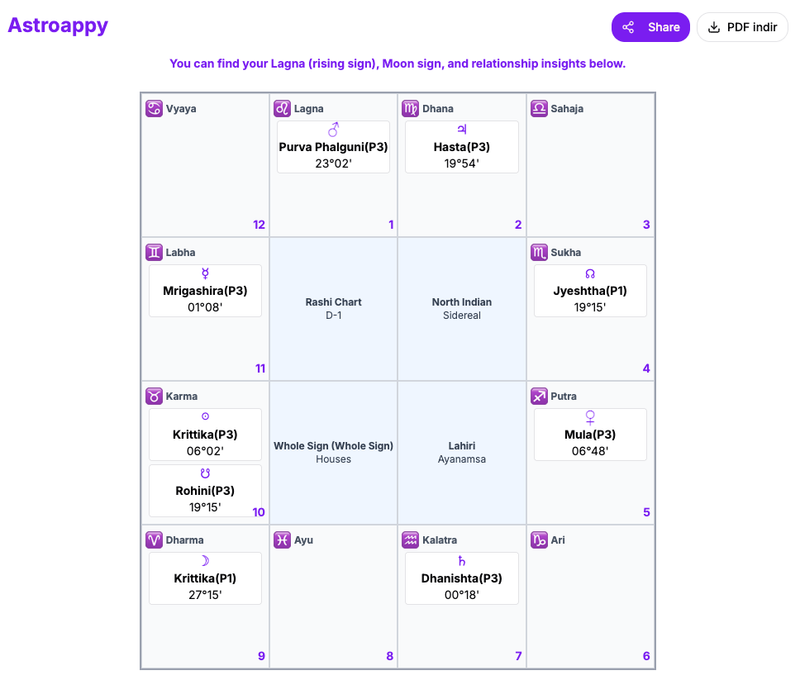
Rashi Chart (D-1) – The Key to the Chart
In Vedic astrology, the interpretation process is carried out based on the fundamental chart called the Rashi Chart. In this square–diamond shaped chart, drawn in the North Indian style, each zodiac sign represents a house. In this system, known as “Whole Sign,” for example, if the Ascendant is in Aries, Aries will always represent the 1st house; Taurus the 2nd house; and Gemini the 3rd house.
On this chart:
- Kendra houses (1, 4, 7, 10)describe a person’s backbone and the most powerful themes on the stage of their life.
- Trikona houses (1, 5, 9)are associated with spiritual gifts and good fortune.
- The Dushtana houses (6, 8, 12)indicate trials, karmic debts, and challenging processes.
For example, let us consider that Venus is placed in the 7th house in Libra and in Swati Nakshatra. In this case, your perspective on relationships is shaped by a quest for aesthetics, freedom, and balance. Your choice of partner is based not only on romance, but also on mental freedom and the mutual honoring of each other’s personal space.

Ascendant (Lagna) and Ayanamsa
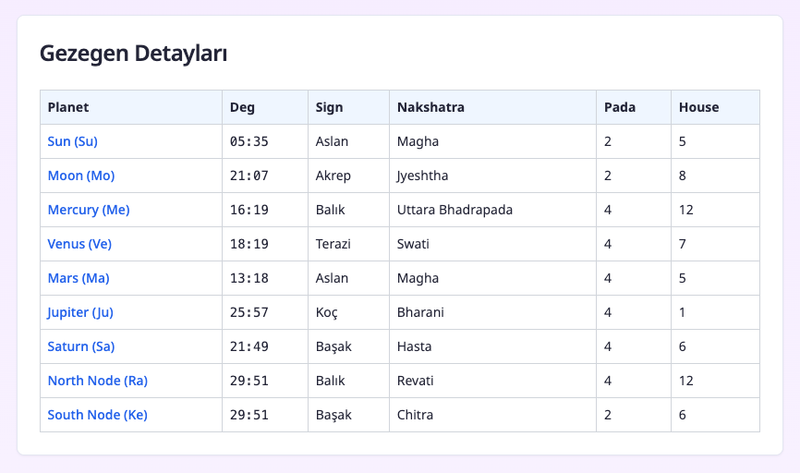
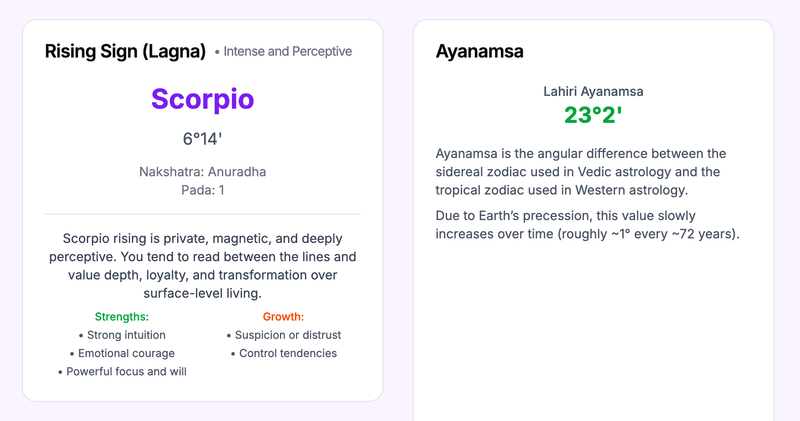
In Vedic astrology, the gateway of the chartis the Lagna. Knowing in which sign, at which degree, and in which nakshatra pada the Ascendant is placed determines the entire interpretation.
For example:
- Aries Lagna, 22°43’ – Bharani Nakshatra, 3rd Pada
This placement brings an innately energetic, direct, and leadership-oriented demeanor. The 3rd pada of Bharani adds themes of responsibility and relational transformation. This person may frequently experience karmic tests in life through relationships.
Additionally, the Lahiri Ayanamsa difference also comes into play here. This difference determines the zodiac shifts between Western and Vedic systems. Very often, a Sun that is in Aries in Western astrology may fall in Pisces in Vedic astrology. This is why knowing your Vedic chart is the most accurate key to understanding your karmic path.
Nakshatra and Pada – The Subtle Calibration of Destiny
The greatest difference between Vedic astrology and Western astrology is that it works not only with zodiac signs but also with Nakshatras, the 27 lunar constellations. Each one covers an area of 13°20′ and every Nakshatra is divided into four parts (padas).
Nakshatras:
- Your mental refinement,
- Your karmic patterns,
- Your spiritual lessons,
- Your tendencies in relationships,
- It determines your orientation in choosing a profession.
For example:
- Sun in Leo, Magha Nakshatra, 2nd Pada→ A theme of devotion to ancestors, leadership, and esteem within the community.
- Moon in Scorpio, Jyeshtha Nakshatra, 2nd Pada→ Intense emotions, intuitive power, and a protective demeanor.
- Venus in Libra, Swati Nakshatra, 4th Pada→ A desire for freedom, grace, and independence in relationships.
As you can see, while zodiac sign interpretations alone remain on the surface, the fine-tuning provided by Nakshatra and pada reveals the deeper layers of the personality.
Interpreting Planetary Placements
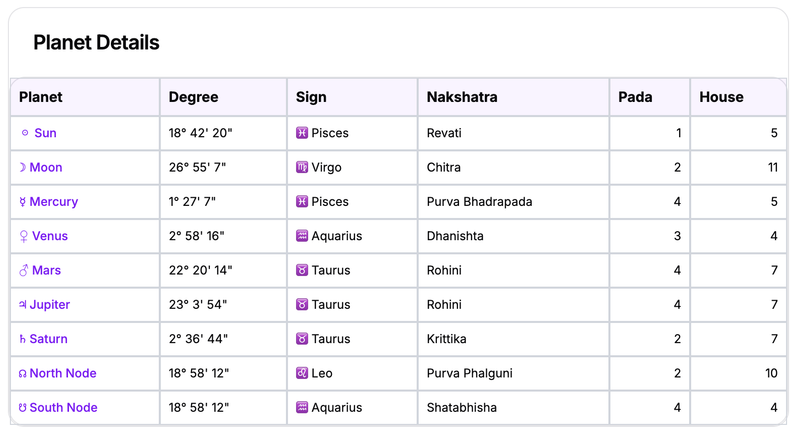
Every planet in the Vedic chart is like a “karmic player.” Its position in the sign, house, and nakshatra reveals which scenes of your life it illuminates.
- Sun (Leo – Magha – Pada 2): Charisma, authority, and prestige in the public eye.
- Moon (Scorpio – Jyeshtha – Pada 2): Intense intuition and protectiveness, but with emotional ups and downs.
- ☿ Mercury (Pisces – Uttara Bhadrapada – Pada 4): Intuitive communication, though at times tending to follow emotion rather than logic.
- ♀️ Venus (Libra – Swati – Pada 4): Freedom in relationships, a graceful yet independent approach.
- ♂️ Mars (Leo – Magha – Pada 4): Strong leadership, a competitive demeanor, and bold actions.
- ♃ Jupiter (Aries – Bharani – Pada 4): Karmic growth, tests in the areas of education and ethics.
- ♄ Saturn (Virgo – Hasta – Pada 4): Discipline, meticulousness, responsibility in the realm of healing.
- ☊ Rahu (Pisces – Revati – Pada 4): Divine vision, compassion, and spiritual journey.
- ☋ Ketu (Virgo – Chitra – Pada 2): Withdrawal from worldly affairs, artistic creativity.
Each of these combinations is a part of your karmic path. For example, having Mars in Leo signifies not only courage, but also a karmic responsibility for leadership.
Reflections of Your Vedic Chart in Your Life
Interpreting the Vedic birth chart is not merely about answering the question, “What is your sign?” This chart:
- Your karmic patternsreveal where you come from and which lessons you carry with you.
- The direction of spiritual growthtells us: In which area is the North Node (Rahu) calling you?
- Reveals relationship and career motivationsby bringing them to light: the 7th house, and the positions of Venus and Jupiter are key here.
- Illuminates your inner potential: The Nakshatras whisper your hidden gifts to you.
What sets the Vedic system apart is that it analyzes events not on a superficial level, but through their karmic depth. The choice of a partner, a career decision, or the direction of a spiritual journey becomes much clearer to understand with this chart.
Another important element to consider when interpreting your Vedic chart is planetary periods (Dasha systems) and transits. The placements at the moment of birth provide the basic framework of your life path; however, to see in which periods you will encounter which lessons and which opportunities will arise before you, a Dasha analysis is needed. For example, when a Venus Dasha begins, themes related to relationships, beauty, and aesthetics may come to the forefront. A Saturn Dasha, on the other hand, can bring lessons shaped by discipline, responsibility, and at times challenges. These periods reveal different stages of your karmic journey and help you understand the larger picture behind the events you experience.
In addition, in Vedic astrology, the Navamsa chart (D-9) is also extremely important. This chart especially reveals marriage, spiritual maturity, and areas of potential growth. These additional divisional charts, which are not very commonly used in Western astrology, prove the depth of the Vedic system. For Vedic astrology does not merely say “this is your sign”; it also shows what kind of transformation awaits you at different stages of your life. Therefore, you should think of your birth chart not only as a single snapshot, but also as a timeline that will gradually unfold in the years to come.
Result
Vedic astrology sees the sky not merely as a zodiac chart, but as a karmic map. Your Lagna is the doorway through which you face the outer world, the Rashi Chart is the stage of your life, and the Nakshatras are the GPS points of your soul. Each planet brings you lessons, gifts, and tests.
If you, too, wish to understand your own journey in depth:
Use Our Vedic Birth Chart Calculator to generate your own chart. Examine the sign, house, and nakshatra combinations of your planets. Discover the potential your soul carries on a karmic level.
The sky reveals not only the stars to you, but also the path of your soul. 🌠
With love,
Astrologer Diana


